Mostrando entradas con la etiqueta Gemology. Mostrar todas las entradas

miércoles, 24 de agosto de 2016

The Story of the Biggest Pearl in the World!

250px-Giant_clam_or_Tridacna_gigas

Hello there and I am very happy to be back in the Blogging saddle! Today I would like to add my commentaries on a recent news that has garnered world attention (in a positive way): the story of the World’s Biggest & Most Humongous Natural Pearl!

This particular pearl is said to weigh in at 34 kilos (a whopping 75 pounds!), which means it is heavier than my 10-year old daughter Jessica. What kind of animal could have made such a humongous pearl? The only mollusk with the size to make this miracle possible is the “Giant Clam” (Tridacna gigas), and the story of a Philippine fisherman and this pearl has –by now- become famous. Many news sites have shared the news, but few have offered a full account of the story, the one I believe had the best account was the Spanish version of BBC News.

And the thing I liked the most about this story has less to do with the pearl and more to do with the Human story that surrounds the pearl.

A New Myth In the Making

It is said that a fisherman was out there doing his “thing” when a storm approached, so he had to return to land. Fortunately for him –in this case it is!- his anchor would not dislodge from the bottom so he could not leave, so he had to dive into the waters to remove the anchor and to his surprise he found a clam had bitten his anchor. What to do next? Obviously he was in a rush to finish this so he picked up the clam, placed it in his boat and then sailed back home; just one small issue that got into my mind: the pearl itself weighs in at 34 kilos/75 pounds and so…just how BIG was the clam?!?!?!?! I mean, these clams can attain a weight of some 300 kilos/661 pounds (some have been said to even reach 400 kilo/881 pounds!) so, it is very likely the clam was a very large one…how could he lift it up from the bottom? How could he manage to raise it up into the boat??? I can almost imagine the fishermen with an average height and weight of 1.70 meters (5.5 feet) and 65 kilos (143 pounds), hauling up this massive animal from out of the water! And it is this is just what makes me think that this entire story is more myth than reality, but this is still a Fantastic & Loveable Story.

Thus, this unnamed fisherman goes back home with this giant clam, unloads it from his boat and hopefully takes it home in a pick up truck (hope some friends helped him with it and they did not leave to their homes since a storm was approaching). He probably prepared the delicious meat of the clam but finding this unusually large and extremely weird shaped pearl was a thing to remember I imagine!

Giant Pearl Tridacna

Now, quite differently to a regular person, this man doesn’t rush out to find a buyer for this great treasure but instead decides to keep this one as a very big lucky charm and places it under his bed for the next 10 years.

Why would he do such a thing?!?!?!? Well, to attract Luck! In some cultures pearls are considered to be great good luck charms that extend their powers even unto the whole family, but the pearl has been appraised at around $100 million dollars…that is sufficiently lucky in my book. Now, unless the pearl has been appraised by a reputable Gem Lab (GIA, SSEF, etc.) I would never pay for one of these giant clam pearls…I would actually only go far as to pay $10 million tops.

What made this man change his mind about the pearl??? A twist of fate: his house burned down. He felt the pearl had not brought him the luck he desired so he decides to give it to the local Touristic authorities, for the good of the whole town of Puerto Príncipe, in Palawan, Philippines. This is an incredibly good willed gesture…unless it may end up burning the entire village (this is absolutely a joke). So far it has begun to work by attracting regional tourism into the town.

What do you think of this story? Do you believe that a lone fisherman found this huge pearl? Is it a real pearl or a polished shell hoax? Whatever the answers are I believe this is one great story!

Turistas perla gigante

jueves, 18 de agosto de 2016

El Pearl Ruckus 2016 del Foro Pearl-Guide.com


Ruckus1

Nuevamente tuve el honor de asistir al evento anual conocido como el “Pearl Ruckus” (Reunión de Perleros) que organiza el foro abierto de perlas más grande del mundo:  Pearl-Guide.com

Este año se cumplió el octavo evento y ha sido –hasta el momento- el de mayor asistencia, con poco más de 40 amantes de las perlas, reunidos alrededor de esta bella gema acuática. La cita fue este pasado 29 de Julio en una enorme mansión en la famosa calle Mullholland en Beverly Hills (la mansión ha sido utilizada para diversos eventos, puedes ver más visitando su página web: the  Palazzo

Este año, las pláticas fueron bastante interesantes, con información muy interesante y con fotografías increíbles. Este ha sido un Pearl Ruckus muy educativo, lo cuál es parte de los objetivos.

Comenzamos el sábado 30 de julio, a las 9 am con la primer plática…que fue impartida por Douglas McLaurin (ese soy yo) y que trató sobre todos los tipos de perlas –naturales y de cultivo- que se producen en México: perlas de Caracolas, de escalopas, de callos de hacha y por supuesto…las famosas Perlas del Mar de Cortez. Acto seguido tuvimos una plática muy interesante sobre el cultivo de perlas en el atolón de Ahe, de parte de mi “hermano de nácar” Josh Humbert, uno de los dueños de la granja de Perlas Kamoka (Kamoka Pearls), para darle la palabra a otro de mis hermanos de nácar: Michael Rivers, productor de los famosos núcleos de concha que utilizamos los perlicultores para producir nuestras bellas perlas de cultivo. Su plática reveló tanto la historia de la pesquería de los mejillones perlíferos como el proceso de producción de los núcleos.

Pasamos después a una plática muy inconvencional de parte de mi amiga la reportera Blair Ruckus2Beavers, que realizó una investigación sobre los fraudes en la venta de perlas en eBay (el equivalente de Mercado-Libre en América Latina, de hecho son la misma empresa)…dato interesante que nos mostró:

  • Las perlas falsas tipo “Shell Pearl” son las más ofensivas: se venden como perlas de cultivo.
  • 99% de las Perlas de Tahití, Akoya y de los Mares del Sur son realmente…perlas chinas de río.
  • Las Perlas del Mar de Cortez también han sido golpeadas en este sitio: hay varios vendedores de auténticas Perlas del Mar de Cortez (como Ehret Design Gallery) pero que realmente te ofrecen perlas chinas.

Tras un generoso receso con bocadillos excelentes (a como nos acostumbraron en estos eventos) regresamos a ver la presentación conjunta de Kevin Canning (CEO de “Pearls of Joy”) y de Jeremy Shepherd (CEO de “Pearl Paradise”) que nos platicaron sobre los importantes cambios que se están dando en la Asociación de la Perla de Cultivo de América (CPAA, por sus siglas en inglés) desde la llegada de Jeremy a dicha institución, siendo la noticia principal la de un nuevo curso (no gratuito) de entrenamiento en todo tipo de Perlas que tendrá una modalidad en línea y que será constantemente actualizado…de forma que quienes lo lleven puedan encontrar nueva información y mantenerse al tanto en esta industria cambiante. La página web del curso es Pearls as One.

Finalmente, tuvimos más presentaciones de gran calibre, empezando con una sobre nuevos y atrevidos diseños en joyería de perlas…saliendo del tradicional molde de “las perlas de la abuelita”. Esta presentación nos la ofreció Jennifer Heebner de la revista JCKRuckus3; entre la lista de diseñadores ella hizo especial hincapié en los hermosos y originales diseños de otra gran amiga: Hisano Shepherd, cuya línea de joyería “Little h Jewelry” ha tomado al mundo del diseño en perlas por sorpresa, ganando una multitud de premios.

Seguimos con otra gran y querida amiga: Sarah Cannizaro de Kojima Pearl Co, quien hizo una gran reseña sobre las famosas perlas Kasumigaura de Japón. Su presentación incluyó fotos históricas tomadas por su mentor Fuji Voll, cuyos padres fueron parte del inicio de la creación del mercado de perlas de cultivo en Europa y Estados Unidos. Si te interesa ver estas fotos te invito a leer su entrada de Blog al respecto aquí. En general, todas estas presentaciones fueron de una calidad excepcional…dignas de un gran foro, seminario o convención.

Al finalizar todas las presentaciones, tuvimos la oportunidad de tener un “Show & Tell” o “Presentación de lo Mejor”, donde cada uno de nosotros exhibimos piezas de joyería y/o perlas de calidad excepcional. Yo tomé el tiempo para llevar uno de los 3 collares de perlas que se han producido este año y la MEJOR PERLA DE LA COSECHA 2016…una belleza de color verde con sobretonos intensos en Violeta, dorado y azul…te invito a ver el video y me despido para continuar con mis labores.

Un saludo a todos y espero verlos pronto en la Granja de Perlas, en Facebook, Twitter o Instagram.


jueves, 30 de junio de 2016

Cortez Pearl VIP Harvest 2016

Again we have this special moment, as expected... the annual harvest of pearls from the sea of Cortez. And in the year 2016, we had the blessing of receiving two very special groups of friends and lovers of this beautiful Mexican Gem:

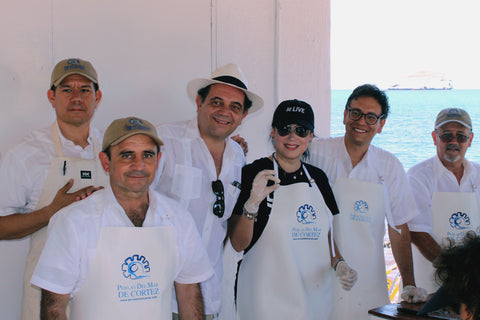
#1: A group of personalities from the city of Mexico, together with our partner and friend Emilio Nassar, in addition to the team from "BeLive" magazine joined us for this very special VIP event.

Evento de Cosecha VIP

#2: A large group of students from the Mexico chapter of the Gemological Institute of America (GIA - Chapter Mexico City), to enjoy what is referred as a "Pearl Safari". In this group we had the honor of having the presence of the President of GIA-Mexico and the IGARM (Institute of Gemology of Mexico): Diana Benoit Seegrove, designer Tania Maria, Melissa Villareal (President of the Monterrey chapter of the GIA) and also an authority within GIA and the world of gems: the renowned photographer and author Robert Weldon.

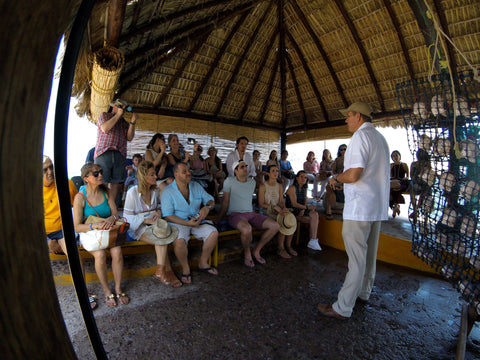
Both groups were pleased to participate first in a special Tour to the Pearl farm, offered personally by Enrique Arizmendi Castillo (founder of the farm), then to another special event with Jose Manuel Nava Romo (also founder): the traditional tribute of the Gulf of California of casting/releasing of pearls into the Sea ceremony; then finally off to the harvest of pearls with the our Company’s Manager,  Guillermo Soberón Chávez and, last but not least, off with Douglas McLaurin-Moreno (last of the founders) to close this much anticipated event.

Enrique en el Tour de las Perlas

Enrique during the Pearl Farm Tour.

Revista BeLive presente en la Cosecha VIP

BeLive magazine team enjoying our Special VIP lunch

At the end of this special moment, we had a variety of refreshing drinks and a delicious snack of fresh snacks: pasta with skewers of shrimp, shrimp salad, fresh tuna tostadas, scallops filled with seafood & vegetables, jicama tacos filled with fresh vegetables...a delight that did not leave anyone unhappy, but with a face of utter satisfaction!

Finally we had a little explanation about the unique properties of the pearls from the sea of Cortez in our jewelry, where in addition the guests could buy our beautiful national gems, unset or mounted in jewelry.

The "Pearl Safari" apart had the opportunity of attending a very interesting talk with Robert Weldon, by reason of his new book "Splendour & Science of Pearls" (it does not even goes on sale but we already have a copy autographed here). I think that it is the first time that Guaymas has a talk at this level in this area of knowledge.

These VIP events were really special... something that not anyone has the opportunity to do, but the event is also made with guests... with whom they come and give life to the event, so thanks to all of you who were part of such special events: thank you!

Here I have a great video edited by Guillermo Soberón-Tirado of our staff at Perlas del Mar de Cortez. Hope you like it.

https://youtu.be/AudY0u5W5L0

Technorati Tags: GIA, IGARM, Diana Benoit, Robert Weldon, pearls, VIP event farm

lunes, 14 de diciembre de 2015

Identifying Pearls: the Body Heat Method

This blog entry is made possible thanks to the direct request of one of my readers. About a month ago, “Carolina” asked me:
"Hello! Somebody in there? …How does the body heat test work? ‘Cause I was told that if I touched my face with an imitation pearl and a real pearl would be able to tell which one is real or fake because the real one is a gemstone and stones are cold. Is this true? I ask because Majorca pearls are made with glass beads and glass is cold…so?"
And I answered her back and I did come to realize that she was right: there is a much needed answer. But I do have to say that this method is not very reliable and there are many factors that can hinder your success rate at identifying pearls…but this is a fun method so let us Just Do It!
And I will also share with you 2 additional methods –just as unreliable as the “body heat test”- but that you may also find interesting: the “Fluidity Test” and the “Sound Test”.
For this blog post I would like to use the Vlog or Video-Blog system to show you how these tests work. For this particular set of tests I will employ 3 different pearl necklaces:
  • A Cortez Pearl Necklace, made with 8 mm round pearls,
  • an imitation pearl necklace from Mallorca Pearls and
  • an imitation strand made with mother-of-pearl (MOP) beads; I have to thank my very good friend Michael Rivers for supplying me with this strand.
Blog-Prueba-Calor-Corporal
Besides these necklaces we require an adequate environmental temperature. What do I mean by this? That for optimum results we require the best environmental conditions for this test: we need a cold & dry environment. Humidity interferes with your abilities and a very warm weather will definitively not help. So try it our during fall, winter and even springtime or inside an air conditioned place.
Now, once you have the necklaces and the adequate conditions you need to know how to use these methods which are based 100% on your sense of TOUCH: you will have to feel textures, viscosity and –of course- heat. There are parts of your body that are more sensitive than others and some people are more sensitive than others too! So don’t expect these methods to work the same way for everyone. I recommend that you master these tests by using different parts of your body –such as your forehead, cheeks and lips- at different times of the day or week because you might discover you are much more sensitive at different times or moments.

Very well then, let’s get our hands dirty! Pun intended.

I recommend you start by comparing two different strands at a time and that you allow some time (at least 3-5 minutes) between tests to “clear” your system from the previous experience. Also, avoid placing your necklaces near any heat source (TV, computer, ovens, etc.).


Finally, the details…

Pearl Fluidity/Viscosity.

It’s not that pearl necklaces are “viscous” but they do slide or flow when you gently slide them against your skin. Pearls are soft and silky, and mostly without sharp edges so they flow very naturally.
On the other hand, imitation pearls (also called fake or faux perles) are coated with plastic and are far less fluid and feel “sticky” when in your hands and are warmed.

Use your lips to slide the pearls in a sensuous manner: bearded men please avoid this or if you feel you do have to this...it please don’t post any pictures. Winking smile

The Body Heat Method

Pearls are made of Nacre and Nacre is made out of Calcium Carbonate. And it so happens that Calcium Carbonate is not such a great heat nor energy conductor and is quite thermo-stable (remains with its own temperature for some time). You need to leave a shell or pearl exposed to a continued source of heat for it to absorb heat…or you may mechanically heat them by polishing or drilling them.
Under a normal body temperature (between 35-37 Celsius or 95-98.6 Fahrenheit) there is not enough heat to noticeably increase the temperature of the pearls (the real ones) and they will quickly cool down…whereas plastic and glass absorb and conserve heat much better than nacre/pearl.

The Pearl Sound (Clinking) Test

There are some that say you can easily id pearls just by the mere sound they produce when the pearls touch each other, when they fall on a given surface or they slither against each other. They produce their own “music”…but I am unfortunate to say I don’t have a very musical ear.

I would not recommend this method but it is quite up to you to use it. Pearls do have a different sound from imitation pearls and other beads but I can’t really distinguish it unless I have the source pearls for comparison.

Final Thoughts

I do hope you have enjoyed this new Vlog format for this Pearl blog, so it becomes much more dynamic and useful for you.

Please do send in your comments!

miércoles, 30 de septiembre de 2015

The Best Cortez pearls of all: 2008-2015

I take off this week by continuing were last I left my blog entry…in an engagingly erotochromic post about the most beautiful Cortez Cultured Pearls of All times!

And we are going to start with the pearl that I personally believe is the MOST BEAUTIFUL CORTEZ CULTURED PEARL that we have ever produced from this farm. And this pearl was produced from the…

2008 Pearl Harvest

Before I tell you about this amazingly, stunningly beautiful pearl I will recount you of hurricane “Julio”, one of the fiercest hurricanes to have hit Guaymas. But fortunately this damage was done after we had harvested our pearls.

This particular pearl is prominently featured in our original “Sea of Cortez Pearl Video” and appeared several times in a thread over at the Pearl-Guide.com forum. It was part of a group of drop shaped pearls that I fondly called the “Drop Dead Gorgeous Pearls”.

This particular beauty had a striking luster to it -all-natural as expected- and at its base it had a very dark purple blue color that started changing into a rainbow of colors until the very tip became a beautiful lavender-pink color, and features amazing overtones. The pearl measures 9.5 mm at its widest and the colors are absolutely EROTOCHROMIC.

I was truly happy to sell this particular pearl to a very good pair of “pearly foster parents” that live in Tel Aviv, Israel. The Holy Land…to me this had a special meaning and over the years this couple became one of my dearest friends. Nora had the pearl set into a pendant-pearl enhancer to use with her Akoya pearl necklace for a very beautiful and striking piece.

The pearl is named “Epyolotli” which is the Nahuatl (Aztec) word for “Pearl” and it means “Heart of the Pearl Oyster”. I really like this name.

2009 Harvest

Then, a year later we also had more splendid pearls…not a single pearl that was equal to Nora’s 2008 pearl but that year was marked by larger than usual pearls.
2009’s largest and most beautiful pearl was sold to one of our US based buyers and I called it “La Bella” or “The Beautiful”: a lustrous, shiny 12 mm near-round pearl with a dark-green body color and a vibrant violet color.
Perlas cosecha 2009 Grandes 008 copy
Here you can see “La Bella” next to other gem grade Cortez pearls of around 10 mm in diameter.
That particular year we barely avoided the farm’s destruction by the disastrous effects of hurricane “Jimena”, which destroyed much of our State’s infrastructure . Guaymas was ravaged by it, so I may not have talked much about this particular pearl. Too much going on.

2010 Harvest

This was –for most Mexicans I believe- a year of shadows and lights: this year marked the 100th anniversary of the Mexican Revolution and 200th anniversary of our Independence from Spain, so it was supposed to be a year of celebrations…but we were in trapped in a terrible economic recession and in the midst of violence –in some parts of our country, but not really around our area- due to the drug trafficking cartels.
But while trapped under conditions we could not help improve (we could neither issue moral fiber –nor brain matter- to our so called leaders) we kept doing what we believe in: growing beautiful and sustainable Cortez Pearls. That year’s harvest was really good and we had one particular pearl that I named as “Matrioshka”, a unique Russian doll-shaped dark purple pearl with beautiful green overtones.

I simply loved this pearl and its name just came out of my mouth when I took it out of it’s mother oyster. Measuring at around 10.5 mm it was purchased by my very good friends Jeremy (CEO of Pearl Paradise.com) and Hisano Shepherd, who had the pearl fitted into a lovely and colorful design made by Hisano. I was so happy to see this amazing pearl become a work of art! The chain actually paid the pearl a fitting homage by also having its contour. Lovely piece isn’t it???

2011 Harvest

The year 2011 was yet another challenging year. I actually don’t want to even talk about some of the things that happened, but I also mark this year as the beginning of my “personal awakening”,  so it was kind of waking up from a terrible nightmare and seeing the light at the end of the tunnel.  One must really be grateful for the “bad times” since they actually build up your character and allow you to become a better version of yourself.
2011’s best pearl was an incredibly erotochromic pearl. A chunky baroque pearl that was so dramatically different that it was like watching a person with a dual personality.
On one of its sides it was a beautiful cyan-true blue color and on its other side it had the same blue with golden and bright violet.


This pearl was purchased at the 2011 Pearl Ruckus by my friend Cathy. I don’t know if she gave this pearl a name but I had called it “Chunky”…I know! Not a glamorous name for a beautiful pearl but to me this name is really special…a pet name of sorts for someone I love.

2012 Harvest

Our worries were definitively not over. This year I fell ill and I was unable to photograph much of the pearls form this harvest. I don’t even recall a personal favorite pearl at all!
Probably the most relevant photo I have is of a group of light colored pearls with a much more colorful pearl. But the photo is simply too bad, totally missing its focus from the beautiful blue pearl in the group.
The Group
But life carries on and on…the next year I saw a major improvement in my health. I truly thank God for allowing me to continue walking on this beautiful blue planet of ours.

Harvest 2013 – Down Under!

The year 2013 was marked by a good harvest: large and colorful pearls with high Chroma. And that year was also marked by having some of the best pearls shipped all the way to Adelaide, Australia.

This lovely trio of pearls went to a my dear friend: Dyann Pryor. And she has great taste in pearls! So, it was fitting to have these incredibly colorful pearls.
You can see some of “Raw Pearls” beautiful Cortez Pearl jewelry line if you visit their site.  I never had the chance to name the pearls…they just left so suddenly.

2014 Harvest

Last year’s harvest was the most abundant ever, reaching 5 kilos of Cortez Pearls. We also had some amazingly colorful pearls and also…who can forget the largest Cortez Cultured Pearl ever?!?!?!? Even if this large pearl was not the prettiest it was definitively out-of-the-ordinary. Here you can see “The Hulk” next to 4 smaller pearls (10, 9 and 8.5 mm) and it just looks Huge!
Perla Gigante 2014 y de 9mm
I named this pearl “the Hulk” due to its purple-green coloration and large size, but for a fleeting moment I considered the name “Barney” (yes, I believe I still suffer from the time spent watching the toddler’s TV program with my children…years go).  Decided to go all out on “The Hulk” since it just sounds more butch than “Barney”.

Specs: Baroque shaped, 17.1 mm in diameter, low luster B+ grade pearl.

Harvest 2015

Now, nearing the end of this story I can try to express some feelings I may have regarding these two posts: it has been over two decades of growing Cortez cultured pearls in the rich waters of the Gulf of California. It has been a story of both beauty and challenges so in essence it is Life itself for us.

For me each pearl harvest reminds me of certain periods of my life and I can re-live and feel the excitement of the “research days” when everything was new and we were making “pearl history”, I can also retell the pain of the “bad years” and –finally- also experience the calmness of my more “experienced years”.  Each one of these pearls in itself retells my personal story, just like a photograph reminds you of certain events and how you looked and felt like.

So, what do I want to say with this? That “Pearls are Like a Snapshot of a Person during a given moment of their Life”… Pearls are Your Personal History: the good, the bad and the experience you gain during life.  I don’t know if any other gemstone is the same, but for me this is True.

So now I finish up with the way all of this began, with a beautiful erotochromic pearl that will soon depart to its new proud owner in the United States…it has been named “Flamingo Silk” by its new owner, Nancy A.

Closing Remarks

I hope you have enjoyed this walk through memory lane and I thank you for listening a bit about my personal story…using my naturally colorful Cortez Pearls as stepping stones.

Until next time.

lunes, 1 de junio de 2015

Unusual Cortez Mabe Blisters


Whoa! This year we have a very special group of out-of-the-ordinary Cortez Blister Pearls…why are these so Special??? Well, let me explain:

  1. Many of these are BIG! As you are well aware our “Rainbow Lip Pearl Oyster” (Pteria sterna) is NOT a Big oyster, more of a mid-sized animal…just between the large “black/silver/gold lips” (Pinctada margaritifera & Pinctada maxima) and the smaller “Akoya Pearl Oyster” (Pinctada imbricata=fucata). The average size of our Cortez Mabe Pearls is 14 mm in diameter.
  2. These Cortez Mabe are VERY BAROQUE, or beyond baroque or simply put: Naturally Shaped. Our Mabe Pearls are never identical and are mostly free-form but leaning towards oval and teardrop shapes.
  3. Their RARITY: this group is very unusual and rare…just 21 pearls out of a harvest of over 2 thousand that we harvested in 2014. Yes, basically just 1.05% of last year’s harvest!
  4. Their ORIGIN: now, this is the final nail in the coffer in a manner of speaking! Why, because this group is basically made up of 100% Natural Blister Pearls that have –for the first time- been processed into Mabe.

Are these really Natural????

Yes. And there is a special story to these. Let me tell you this story.

Back in 2012, when we were seeding our pearl oysters we started to notice something odd in them…snails. There were hundreds of these snails we had never seen before. There were so many that we found them with the oysters and we started noticing some INSIDE of the Rainbow Lips too!

Caracol Adulto que creemos esta metiendose en Pteria sterna (1)

At that same time we received a group of Malacologists from Florida and we told them about this issue, they kept some specimens and headed back. Manuel and I started looking for the name of this unknown snail and we came up with the same name, later we received confirmation from Florida: Vitularia salebrosa, an ecto-parasitic snail of the Murex family. This blew my mind!

I had never seen such a variety of snail before and I had never seen how they actually found their way inside the oyster’s shell to suck its blood like an armored leech (yes, they suck the blood of its host), you can actually read all about it in this scientifically detailed article.

Well, the oysters don’t have their “Vampire Hunters” but instead they use the millennia old trick they know all too well: if it harms you, turn it into something beautiful…just make a Pearl!

But at the moment I was looking at these snails I just wanted to know more about them, and because of this I just left the snail inside the oysters allowing Nature to follow its course. And Nature did its thing.

We collected and photographed some of these nails, we found them in all colors and sizes. That year was the year of the Parasitic Snail.

Caracol, snail, Vitularia salebrosa 044

We find them rarely these days. Must have been one of those “weird natural cycles” that Nature usually surprises us with. Unfortunately I can’t seem to find the photos I took of these snails as they were being coated with protein by the oyster. I kept one shell with its snail, but dehydration has pretty much damaged the shell.

Vitularia salebrosa in Pteria sterna shell (1)

Vitularia salebrosa in Pteria sterna shell (2)

This is the first time ever such an event has been described with these species of mollusks.

Another very interesting and noticeable feature is what I would call “Health”. Sick or unhappy oysters usually have a very dull shell, whereas “happy” or healthy oysters display beautiful colors. The oyster shell with the parasitic snail looks quite unhappy.

Shell comparisson

So, now you finally understand why these pearls are all so Special and Unique. In a way they tell us a unique story of how we can all withstand pain, endure and ultimately create something beautiful from it.

If oysters can do it so can we do it. It is your choice to create your own glorious pearl.

WP_20150601_11_26_57_Raw

These pearls will soon become available for purchase in our e-Sales website

, but you can also write to secure your own! Remember we only have 21 of these ready for you to set them in Jewelry and enjoy Nature’s perplexing beauty.

P.S.: I hope you don’t write in to tell me that “Pearls are produced by a Grain of Sand”. I finally have overcome my anxiety towards this myth and won’t go into a fit ;)

Cheers!!!

sábado, 25 de abril de 2015

The 2015 Tucson Gem Show part 2 – Final comments

Amazing. We are are almost about to start with the month of May and I am about to write about things that happened way back in February. Goes to show how tight a schedule I have.

But here I am again sharing my thought and comments, hoping some of these things will be of help and interest to you all. So, let me know start with the JEWELRY, a most pleasant subject.

This year we were pleasantly surprised by our many talented friends. Kathe of TriGem Designs, Alejandra of Alejandra and Sarah of Kojima Pearl have been busy producing some of the most beautiful Cortez Pearl jewelry designs we have been able to see these last years. Gold, silver, gemstones and Cortez Pearls are all combined to produce wearable beauty to please the beautiful women that grace our fair Earth. Let me show you some of the beautiful pieces we saw in Tucson this 2015 and some that even made it all the way to our Cortez Pearl Jewelry store in Guaymas (and that you may also see in our eStore

).

Kathe Mai of  TriGem Designs

Kathe’s jewelry designs may be easily explained with just one word: Timeless. These are classic pieces that could have been worn 100 years ago, but also worn today and will be worn 100 years from now. Simply put: these are jewelry designs that will not suffer from the ravages of “fashion statements”. You may agree or disagree with me…but I believe you will agree these are beautiful pieces, and all of their accompanying stones are Fair Trade Gems as usual.

Another great thing about her jewelry is that it feels equally at home being worn with a fancy night dress or with just normal day wear such as jeans. My personal favorites are the 14K Rosé Gold with Cortez Mabe and Nyala Rubi piece and the 18K Yellow gold Cortez Mabe piece that has little moveable gold waves…reminds me of a jellyfish.

Joyeria-de-TriGem-Designs-2

This year Kathe came out with more Cortez Mabe Pearl jewelry designs and she is also busy preparing a new line of jewelry for this year…a special line that we will not disclose until it is ready. Expect something special later this year!


Alejandra Solomone of Alejandra Jewels

Alejandra has a hectic and contrasting life: she moves and feels equally at home in the great city of New York and her mother’s ranch in the Sierra Madre in Mexico. Quite a contrast! She is both a sophisticate cosmopolitan woman and a horse mounted Amazon and her jewelry also defies our imagination with its colorful designs.

This year she incorporated even more colors in her new designs –all of them available at our eStore and here in Guaymas- with the help of beautiful Mexican Fire Opals, Granates, Sapphires and Diamonds. This year she worked wonders on our Cortez Pearls, Mabe and Keshi.

Joyería-Alejandra-2015

Yesterday we were preparing our first ever TV commercial (to air on State television here in Sonora and in TV Azteca Arizona) and Rocío chose a pair of beautiful earrings by Alejandra for this special occasion. I believe you can agree they look stunning.


Sarah Cannizaro of Kojima Pearl Co

Our dear friend Sarah is increasing her Cortez Pearl inventories and she has been coming up with many special requests by pearl connoisseurs…her recent designs also incorporate the inspiration of her husband Mounir. You can see his vision on the pair of Mabe Pearl earrings, a great contrast with the violet stones and the Cortez mabe pearls.

I expect to see many more great designs from Sarah and Mounir in the years to come. You can find more of Sarah and Mounir’s jewelry at the Kojima website…and they also carry a great selection of Kamoka Pearls -from our friends Josh and Celeste- and have exclusive Kasumiga pearls as well, so you can’t really go wrong with Kojima if you intend to find that “special pearl” that we all are looking for.

Sarah-joyeria-2015

And that is that in the case of Cortez Pearl Jewelry at this year’s edition of the Tucson Gem Show. For now I will shift gears into two very different subjects: Great Food & Great friends and Mexican Fire Opals.


Mexican Fire Opals by Opalos & Artesanias Mexicanas

I love pearls above all gemstones. In a close second place I have Opals, followed by Emeralds and Amber. I am not that fond of the shiny, glittering stones…but Fire Opals are special to me, they can also have such varied looks! I mean: some can look glacial white, others are a flaming orange, then bright Yellows and even a soft soapy pink! You would think you are talking about different stones but no, these are the Opals of Mexico and our friend Luciano Tamayo and his family are the owners of the best mine in Jalisco. They have taken the art of Opal processing to a new level and offer them in very conceivable shape, size and colors…from minimalistic rough-cut opals to perfect cut opals and everything in between like the baroque shaped opals that Alejandra used in her Cortez Keshi and Opal earrings.

Opals

Our friend Luciano and his family are always ready to take care of your special Opal needs at the Tucson Gem Show (same tent as we are, the GJX just across from the Tucson Convention Center) and you can contact them via e-mail too.


Great Dinners with Great Friends

I believe the Pearl Industry is special and different from all others. Over the years you end up making great friends, all sharing this common passion for pearls and jewelry. This year we had our nights filled with laughs, merry drinks and great food…but it is the friends we join the ones that actually make it a special moment. Thank you all for your friendship, for being gracious hosts and for sharing your love and knowledge of pearls (and Spirits!) with us.

Dinner-Friends

And with these last words I bid you all a Great Spring!

sábado, 21 de febrero de 2015

The Tucson Gem Show, part 1

February 4th, 2015: Here I am reporting from Tucson, Arizona, in what is considered the largest international gems & mineral show, a city that becomes a haven for precious gems, semi-precious stones, fossils and all kinds of jewelry in the world. This year -and every year since 1995- we are displaying our exclusive and unique Cortez Pearls, and every year I try make a small report about the people, companies, products or events that drew my attention,and this year is no exception.

But before I begin with a general report of 2015’s Tucson Gem Show I want to start with a very quick report about our Cortez Pearls production. I will begin with the information about our 2014 Pearl harvest.

The 2014 Cortez Pearl Harvest

The year 2014 will go down in the annals of our history as a bittersweet year: we had the best pearl harvest in our history: after more than 15 years of commercial pearl production, we finally reached the goal of the 4 kilos of Cortez Pearls (this means just around 4,000 pearls). But despite the very good news, we also had problems with the environment (global warming) and this resulted in a very high mortality in the group of oysters that will allow us to produce pearls in the year 2016. Because of this reason, we have had this bittersweet situation.

Some of the novelties of 2014 and that we are showing here at the Tucson Gem Show are these:

We have a new variety of Cortez Mabe Pearl on sale: we call it the "Mini-Mabe", these are Mabe pearls that have a lower dome height and a smaller diameter (this means, much smaller than traditional Cortez Mabe), but this gives them a lower value of investment and -in addition- it also allows the jeweler or designer to use less metal to produce jewelry items that are more affordable for the end user. These pearls have been used by our Australian distributor (Raw Pearls of Adelaide) with great success, and these lovely little Mabe have caused a great impact at the Gem Show and are all but almost exhausted.

145870_thumb4 

Raw Pearls Turtle Pendant w/Cortez Mabe

News

For this show's gems have been exhibiting the Cortez Pearls of the 2014 harvest (the 2015 harvest will take place in the middle of this year) and among the most important items I have to mention is the beautifully unique 2014 Cortez Pearl necklace. This beautiful necklace consists of 43 cultured pearls from the Gulf of California, all the pearls were produced by our exclusive "Rainbow Lip Pearl Oyster" (Pteria sterna) and was made with pearls of at least 6 different yearly harvests. This multicolor, graduated necklace is made with pearls that measure between 8.3 mm and 10.6 mm, with the central Pearl -an incredible dark purple-red Cortez Pearl- measuring 11.3 mm. What else can I tell you about this beautiful necklace? It is an extremely rare piece, this would be the 11th Special Cortez Pearl Necklace that we have produced with this finesse and quality... and it's a uniquely special piece, the owner will even have the right to Christen it with a unique name and this name will be linked to the necklace for generations to come.

WP_20150205_007_thumb4

http://www.perlasshop.com/blog/wp-content/uploads/2015/02/WP_20150205_007_thumb.jpg

Cortez Pearl Necklace 2014

Among the pearls that came to Tucson, we have the large Cortez Blister Mabe Pearls, which this past year were more abundant than in other years, but that ultimately are a little more than 100 pearls... these pearls have beautiful colors and larger sizes (reaching up to 5 cm/2” in diameter), and are perfect for producing pieces of jewelry with a high visual impact.

Mabe-U-Blister-014_thumb4

Cortez Mabe Blister

In general this year’s gem show had a special flavor to it, something which I had not felt in many recent years and that I can only describe in a single word: enthusiasm.

This enthusiastic atmosphere seemed widespread amongst buyers and most of the sellers, and I believe this optimism may be due to the recovery or improvement of the United States economy (although customers from Canada and other oil exporting countries were not in the same spirit). Let us hope that this spirit will also translate into an overall growth of the international jewelry industry.

Note: The information you have read up to the previous paragraph was written while at the Tucson Gem & Mineral Show, but as of this moment the report was written on February 11th. There was simply too much work at our booth and I could not continue with a "live and direct" report.

Elisabeth Strack’s Pearl Presentation (AGTA)

The AGTA carries out seminars and lectures by expert gemologists, designers and industry analysts every year. This year was no exception and we were lucky to go to the presentation of one of the foremost authorities in the world of pearls: German Gemologist Dr. Elisabeth Strack, author of what many (myself included) consider to be the Pearl Bible: "Perlen".

WP_20150205_15_49_19_Pro_thumb6

The presentation took place on February 4th at the Tucson Convention Centre and  Dr. Strack spoke mainly about three issues:

1) the “new wave” of natural pearls, mainly made up of non-conventional species (non-nacreous pearls from snails, clams and even the Nautilus) and

2) a review of some pearl innovations, such as the Galatea Pearl and the “Provoked Baroques” as well as a redefinition of freshwater pearls based on their production system (Note: if interested, my friend Caitlin Williams wrote an amazing article on the Evolution of the Freshwater Pearl on the PearlsOfJoy.com website. I recommend Caitlin’s article wholeheartedly).

3) the Natural Pearl Market: Something that seems very important to stress is that Dr. Strack explained that the way in which you can assign a monetary value to a natural  pearl no longer obeys the “old pricing rules” which seemed to function for centuries; she basically states that today the value of a pearl is just a "thing of the market", where the price of the pearl basically depends on what a customer is willing to pay for it. Wow.

She mentioned the famous that the once popular pearl pricing "Rule of Tavernier", named in honor of Jean Baptiste Tavernier (a great Explorer and French merchant of the 17th century who discovered the famous "Tavernier Blue" diamond) is no longer the “rule of thumb” for natural pearl pricing. This rule basically consists of a system based upon two factors and their interaction:

  • The "Size Factor": basically the weight of a Pearl is obtained in grains (a grain being equal to 64.79891 milligrams) and this value is then multiplied by itself. Thus, if a Pearl weighs 4 grains its size factor value will be equal to (4 x 4 =) 16.
  • The "Multiplier Factor" or of Quality/Beauty: Tavernier established a range between 0.5 and 30 as a possible value for the pearl’s quality or beauty.  Pearls of little or no beauty will be valued between 0.5 and 3, while the more "normal" pearls fall within the range of 15 to 20, and exceptionally beautiful pearls -the so called "gems"- will fall within the range between 25 to 30. Once you select the appropriate number you proceed to...
  • Multiply the Factors: take the resulting number of "Size Factor" (SF) and that of the "Multiplier Factor" (MF) and multiply them. In an example, lets us say that we have two pearls, one being very beautiful (MF = 30) and a far less graceful one (MF = 0.5); if both weigh the same (8 grains, SF = 16) then we have that the price of the gem pearl will be $480 and the less graceful one will be worth just a mere $8.

And in what currency is the value of the Pearls set in the examples above? In US dollars according to Strack (for more information, you can consult Elisabeth Strack’s book "Pearls" on pages 297 and 298). I assume that there was another currency in use in the times of Monsieur Tavernier, very probably the most international currency of the day was the "Mexican Peso" (also known as "Real Español"), but Dr. Strack found a way to upgrade its outdated value to a 2006 equivalent (date of the publication of her book). We are fortunate to have it so easy.

But again, for Elisabeth Strack, the price of natural pearls today is completely out of all rules and simply depends on the "market".

An example she provided with a pair of natural Pteria sterna pearls, the same oyster that we use to produce our beautiful Cortez Pearls, is revealing. In this example, she had the photo of two tear-drop shaped pearls, one of weighing 10.15 ct (carats) and the other one at 1345 ct; these were sold to a final price of $2,600 to $26,390 USD USD/ct...equivalent to some by smaller Pearl and $34,970 USD by the greater size.

WP_20150204_09_24_13_Pro_thumb1

Having used the rule of Tevernier, the value of these same pearls would be a little different (I'll use a 15 FM for example):

10.15 ct = mg = 31.33 2,030 grains then 31.33 x 31.33 x 15 = $14,723 USD

1345 ct = mg = 41.51 2.690 grains then 41.51 x 41.51 x 15 = $25,846 USD

In this case the price could be very different, since I don't have the actual MF value assigned to these pearls, but changing this value would obviously make a huge difference.

It's really rare to find pearls like those in the example above, so if you do find a natural pearl… first you should consider its size/weight and then its beauty. Please do not become too emotional with the price and then do consult with an expert in this field before you actually tell your boss you quit and will move next to your favorite movie star’s house.

It is very important that you know and understand this: these prices are the end customers pay. What I mean by this? That these would be the prices that people pay as Bill Gates, Carlos Slim,

Paul Allen, Mark Zuckberg, etc... and not are prices that could pay the intermediaries, which are those who buy these pearls and can offer them to another intermediary (the famous Jewelers like Tiffany, Cartier, Harry Winston, etc.) who is who ends up offering these gems to moguls. The only way in which you could access these prices is you go directly to the final customer... it would be good to know them and they you know you so you open up the doors.

At the moment it is the information that I am going to share this great annual event in Arizona, but next week I will continue with additional information about the event. I hope that the information is of utility and interest and here my kind readers I'll be sharing my expert advice with you.

viernes, 29 de agosto de 2014

Big Cortez Pearl

The BIGGEST Cortez Pearl Ever.

17mm Cortez Baroque PearlOh yes! It happened this year. Finally after years of never seeing a really large Cortez Pearl we had the unique opportunity of harvesting a freakishly giant pearl measuring 17 mm in diameter. This huge dark-gray/purple baroque pearl is uniquely different from previous large Cortez Pearls because:

  • The largest Cortez Pearl was a 14 mm baroque pearl that was not solid. It was a “gas giant pearl” and these pearls are usually filled with a stinky dark liquid (which I fondly call “Pepe” for “Pearl Petroleum”) and do not have a very thick coating of pearl. When the putrid liquid is removed (cleansing the interior with hydrogen peroxide) you are left with a very light and hollow pearl.
  • The largest solid Cortez Pearl was a 12 mm near round pearl that was harvested in 2012. The largest nuclei (pearl beads) we employ for the production of a cultured pearl will measure 10 mm, so this large pearl is quite solid with 2 mm of nacre growth (or 1 mm of nacre to each “side”).

So this information –and the one that follows- basically lays down the information needed to hopefully understand what makes this Giant Cortez Pearl special and why it is most unlikely we will ever see another pearl like this in many, many more years. This is truly a one of a kind pearl. Let me explain some basic pointers.


The Pearl Sac

The Rainbow lipped pearl oyster is an animal with a tiny pearl sac. The “pearl sac” is -technically speaking- just a very thin layer or nacre producing cells that grow on top of the pearl (and initially on top of the mother-of-pearl nuclei), but many people refer to this sac as the “general anatomic area” where the pearl is growing. To place this in a context it is like when people refer as that “a baby is growing in a mommy’s tummy” as opposed to stating that “a fetus grows within the uterus”, so I hope you get the idea. So, the pearl sac of this species (the general pearl producing area) is incredibly small. Tiny. Insignificant. To give you an idea of how small it is you can watch a video of the extraction of a pearl from any other variety of pearl oyster and one from the rainbow lip. You will see the big difference!

https://www.youtube.com/watch?v=FSyFTvHuadY

Let me tell you a story of something that happened to me back in 2012 or 2011…can’t really recall the year. I was at the pearl farm when I was told we had some special visitors. Went up to meet with them and they were a couple of pearl farmers from Tahiti. I will not state their names in public out of respect of their privacy. So, I greeted them and they wanted to see the farm and in the end they requested me to open up an oyster so they could see its shell and anatomy (I could imagine a bit of “technical espionage” there, but no harm can come of something as simple) and when I did…that is when I was amazed! Their reaction was astronomically unique! Their eyes seemed to “pop out” of their heads, a look of utter disbelief painted in their faces and they would look at the animal then at my face then back at the oyster then back at my face and this in a very fast manner! Finally he was able of uttering this phrase: “How…how can you EVEN produce pearls larger than 8 mm!?!?!?!?!”

Pinctada margaritifera vs Pteria sterna

Well, their experience is rooted in the Tahitian Black lip oyster (remember: genus Pinctada) which is not only a much larger sized animal but also it has a very conspicuously large “pearl sac” in comparison with the Pteria sterna which has a very tiny and compact “pearl sac” surrounded by the animal’s intestines too. So, from their experience what we were doing producing pearls in sizes between 8 to 12 mm is simply impossible. It took them some time to regain composture, then they left and I have never heard from them again. Not even a postcard.

Nuclei Sizes

BigCortez2Since our rainbow lip oyster has this tiny pearl sac we can only use “small” mother of pearl beads. The smallest sized beads we use are the 6 and 6.5 mm nuclei (our average size when seeding oysters) and we also have other larger sizes, our biggest nuclei being a 10 mm bead. I –personally- very rarely use that size…and since we keep the information on the biggest sized beads we use for every daily operation during the pearl seeding season I can tell you with a 100%

degree of certainty that I have been unable to use a bead in this size since 4 years ago.

So, the 12 mm pearl I mentioned before was quite obviously the product of a 9.6 or 10 mm nucleus, but this larger pearl was actually the product of a smaller bead: for that given day of seeding, the largest nucleus I used measured only 9.3 mm. If this particular pearl is the product of such pearl it means that it has a whopping 7.70 mm of nacre around the bead! This is clearly a lot more than the typical coating of 1.5 to 2.3 mm of nacre we see in our Cortez Cultured Pearls.

The photo on the right side displays the large baroque pearl with some “smaller” pearls (8.5 to 9.5 mm in diameter).

Why is this Pearl SO BIG?!?!?

I don’t really know. This is a mystery that only the destruction of the pearl or an advanced pearl analysis may help us understand and I would welcome an offer to analyze this pearl before it can be sold or goes into our “Pearl Museum” display.

My only guess is that the pearl producing cells of that rainbow lipped oyster worked under a different metabolic rate, probably in a state of angiogenesis (similar to what tumor cells do in our bodies, by promoting the growth of blood vessels to feed the tumor and allow it grow), but this is simply my guess.

So, what do you think made this pearl possible??? I leave you with this thought… cheers!

miércoles, 12 de febrero de 2014

The Tucson Gem Show, part 1

February 4th, 2015: Here I am reporting from Tucson, Arizona, in what is considered the largest international gems & mineral show, a city that becomes a haven for precious gems, semi-precious stones, fossils and all kinds of jewelry in the world. This year -and every year since 1995- we are displaying our exclusive and unique Cortez Pearls, and every year I try make a small report about the people, companies, products or events that drew my attention,and this year is no exception.

But before I begin with a general report of 2015’s Tucson Gem Show I want to start with a very quick report about our Cortez Pearls production. I will begin with the information about our 2014 Pearl harvest.

The 2014 Cortez Pearl Harvest

The year 2014 will go down in the annals of our history as a bittersweet year: we had the best pearl harvest in our history: after more than 15 years of commercial pearl production, we finally reached the goal of the 4 kilos of Cortez Pearls (this means just around 4,000 pearls). But despite the very good news, we also had problems with the environment (global warming) and this resulted in a very high mortality in the group of oysters that will allow us to produce pearls in the year 2016. Because of this reason, we have had this bittersweet situation.

Some of the novelties of 2014 and that we are showing here at the Tucson Gem Show are these:

We have a new variety of Cortez Mabe Pearl on sale: we call it the "Mini-Mabe", these are Mabe pearls that have a lower dome height and a smaller diameter (this means, much smaller than traditional Cortez Mabe), but this gives them a lower value of investment and -in addition- it also allows the jeweler or designer to use less metal to produce jewelry items that are more affordable for the end user. These pearls have been used by our Australian distributor (Raw Pearls of Adelaide) with great success, and these lovely little Mabe have caused a great impact at the Gem Show and are all but almost exhausted.

145870

Raw Pearls Turtle Pendant w/Cortez Mabe

News

For this show's gems have been exhibiting the Cortez Pearls of the 2014 harvest (the 2015 harvest will take place in the middle of this year) and among the most important items I have to mention is the beautifully unique 2014 Cortez Pearl necklace. This beautiful necklace consists of 43 cultured pearls from the Gulf of California, all the pearls were produced by our exclusive "Rainbow Lip Pearl Oyster" (Pteria sterna) and was made with pearls of at least 6 different yearly harvests. This multicolor, graduated necklace is made with pearls that measure between 8.3 mm and 10.6 mm, with the central Pearl -an incredible dark purple-red Cortez Pearl- measuring 11.3 mm. What else can I tell you about this beautiful necklace? It is an extremely rare piece, this would be the 11th Special Cortez Pearl Necklace that we have produced with this finesse and quality... and it's a uniquely special piece, the owner will even have the right to Christen it with a unique name and this name will be linked to the necklace for generations to come.

Collar Fino 2014 (1)

Cortez Pearl Necklace 2014

Among the pearls that came to Tucson, we have the large Cortez Blister Mabe Pearls, which this past year were more abundant than in other years, but that ultimately are a little more than 100 pearls... these pearls have beautiful colors and larger sizes (reaching up to 5 cm/2” in diameter), and are perfect for producing pieces of jewelry with a high visual impact.

A Grade Blisters (2)

Cortez Mabe Blister

In general this year’s gem show had a special flavor to it, something which I had not felt in many recent years and that I can only describe in a single word: enthusiasm.

This enthusiastic atmosphere seemed widespread amongst buyers and most of the sellers, and I believe this optimism may be due to the recovery or improvement of the United States economy (although customers from Canada and other oil exporting countries were not in the same spirit). Let us hope that this spirit will also translate into an overall growth of the international jewelry industry.

Note: The information you have read up to the previous paragraph was written while at the Tucson Gem & Mineral Show, but as of this moment the report was written on February 11th. There was simply too much work at our booth and I could not continue with a "live and direct" report.

Elisabeth Strack’s Pearl Presentation (AGTA)

The AGTA carries out seminars and lectures by expert gemologists, designers and industry analysts every year. This year was no exception and we were lucky to go to the presentation of one of the foremost authorities in the world of pearls: German Gemologist Dr. Elisabeth Strack, author of what many (myself included) consider to be the Pearl Bible: "Perlen".

Elisabeth Strack revisando perlas naturales de Edgar Rodriguez (3)

The presentation took place on February 4th at the Tucson Convention Centre and  Dr. Strack spoke mainly about three issues:

1) the “new wave” of natural pearls, mainly made up of non-conventional species (non-nacreous pearls from snails, clams and even the Nautilus) and

2) a review of some pearl innovations, such as the Galatea Pearl and the “Provoked Baroques” as well as a redefinition of freshwater pearls based on their production system (Note: if interested, my friend Caitlin Williams wrote an amazing article on the Evolution of the Freshwater Pearl on the PearlsOfJoy.com website. I recommend Caitlin’s article wholeheartedly).

3) the Natural Pearl Market: Something that seems very important to stress is that Dr. Strack explained that the way in which you can assign a monetary value to a natural  pearl no longer obeys the “old pricing rules” which seemed to function for centuries; she basically states that today the value of a pearl is just a "thing of the market", where the price of the pearl basically depends on what a customer is willing to pay for it. Wow.

She mentioned the famous that the once popular pearl pricing "Rule of Tavernier", named in honor of Jean Baptiste Tavernier (a great Explorer and French merchant of the 17th century who discovered the famous "Tavernier Blue" diamond) is no longer the “rule of thumb” for natural pearl pricing. This rule basically consists of a system based upon two factors and their interaction:

  • The "Size Factor": basically the weight of a Pearl is obtained in grains (a grain being equal to 64.79891 milligrams) and this value is then multiplied by itself. Thus, if a Pearl weighs 4 grains its size factor value will be equal to (4 x 4 =) 16.
  • The "Multiplier Factor" or of Quality/Beauty: Tavernier established a range between 0.5 and 30 as a possible value for the pearl’s quality or beauty.  Pearls of little or no beauty will be valued between 0.5 and 3, while the more "normal" pearls fall within the range of 15 to 20, and exceptionally beautiful pearls -the so called "gems"- will fall within the range between 25 to 30. Once you select the appropriate number you proceed to...
  • Multiply the Factors: take the resulting number of "Size Factor" (SF) and that of the "Multiplier Factor" (MF) and multiply them. In an example, lets us say that we have two pearls, one being very beautiful (MF = 30) and a far less graceful one (MF = 0.5); if both weigh the same (8 grains, SF = 16) then we have that the price of the gem pearl will be $480 and the less graceful one will be worth just a mere $8.

And in what currency is the value of the Pearls set in the examples above? In US dollars according to Strack (for more information, you can consult Elisabeth Strack’s book "Pearls" on pages 297 and 298). I assume that there was another currency in use in the times of Monsieur Tavernier, very probably the most international currency of the day was the "Mexican Peso" (also known as "Real Español"), but Dr. Strack found a way to upgrade its outdated value to a 2006 equivalent (date of the publication of her book). We are fortunate to have it so easy.

But again, for Elisabeth Strack, the price of natural pearls today is completely out of all rules and simply depends on the "market".

An example she provided with a pair of natural Pteria sterna pearls, the same oyster that we use to produce our beautiful Cortez Pearls, is revealing. In this example, she had the photo of two tear-drop shaped pearls, one of weighing 10.15 ct (carats) and the other one at 1345 ct; these were sold to a final price of $2,600 to $26,390 USD USD/ct...equivalent to some by smaller Pearl and $34,970 USD by the greater size.

Having used the rule of Tevernier, the value of these same pearls would be a little different (I'll use a 15 FM for example):

10.15 ct = mg = 31.33 2,030 grains then 31.33 x 31.33 x 15 = $14,723 USD

1345 ct = mg = 41.51 2.690 grains then 41.51 x 41.51 x 15 = $25,846 USD

In this case the price could be very different, since I don't have the actual MF value assigned to these pearls, but changing this value would obviously make a huge difference.

It's really rare to find pearls like those in the example above, so if you do find a natural pearl… first you should consider its size/weight and then its beauty. Please do not become too emotional with the price and then do consult with an expert in this field before you actually tell your boss you quit and will move next to your favorite movie star’s house.

It is very important that you know and understand this: these prices are the end customers pay. What I mean by this? That these would be the prices that people pay as Bill Gates, Carlos Slim, Paul Allen, Mark Zuckberg, etc... and not are prices that could pay the intermediaries, which are those who buy these pearls and can offer them to another intermediary (the famous Jewelers like Tiffany, Cartier, Harry Winston, etc.) who is who ends up offering these gems to moguls. The only way in which you could access these prices is you go directly to the final customer... it would be good to know them and they you know you so you open up the doors.

At the moment it is the information that I am going to share this great annual event in Arizona, but next week I will continue with additional information about the event. I hope that the information is of utility and interest and here my kind readers I'll be sharing my expert advice with you.